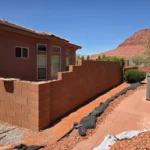
Yes, raising a block wall can be an option for more privacy, but only when the existing wall, footing, reinforcement, and site conditions can support the finished height. A wall that looks straight is not automatically suitable for extra courses of block.
For a St. George homeowner, the first question is what the added height needs to accomplish. Screening a seating area is different from blocking the view from an elevated neighboring yard. Before raising a block wall, check the actual sightline from the space you want to use.
Start with the privacy problem
Stand where you normally sit, walk, or entertain. Identify where the unwanted view comes from and mark the proposed top of the wall with your contractor. Check it from more than one position.
This simple planning step can prevent an expensive disappointment. When raising a block wall for privacy, an extension might screen a ground-level patio while doing little to block a second-story window. A taller wall along the entire boundary may also be unnecessary if the problem is limited to one seating area.
Explain your goal in practical terms: “I want privacy while sitting on this patio” gives a contractor more useful information than “I want two more rows.”
What to check before raising a block wall?
The assessment should address the whole wall assembly, including what is hidden below ground. Ask how the following will be verified:
- The existing footing and its suitability for the proposed finished wall.
- The wall’s thickness, reinforcement, grouting, and connection to its base.
- Cracks, leaning, loose units, previous repairs, and evidence of movement.
- The proposed connection between the new work and the existing structure.
- Changes in ground level and whether the wall also holds back soil.
CMHA’s concrete masonry fence guidance explains that footings resist sliding and overturning and that reinforcement connects the wall to its support. Added height changes the structural question; it cannot be evaluated by counting blocks alone. Concrete Masonry Fence Design provides background on these principles, rather than a ready-made design for an existing wall.
If construction records are unavailable, ask what investigation is needed. Do not assume the original wall contains reinforcement simply because it has stood for years.
A retaining wall needs a different conversation
If one side of the wall has higher soil, tell the contractor before discussing an extension. A wall that retains soil has demands beyond privacy screening. Its existing purpose, loading, and drainage need to be understood before more height is considered.
Also mention any planned changes nearby, such as a new parking area or raised landscape bed. The assessment should consider the finished project, including changes that have not been built yet.
Check the property rules before choosing a height
Ask the City of St. George to confirm the requirements for your exact wall location and proposed height. Front setbacks, corner visibility, and retaining-wall conditions can change the review. Check any applicable HOA requirements and clarify the boundary before modifying a shared or property-line wall.
The city’s fence and retaining-wall regulations are the starting point. A neighbor’s existing wall is not evidence that the same height or arrangement will be approved on your property. Properties in Washington, Ivins, Santa Clara, or Hurricane should be checked with their own jurisdiction.
Will the extension match?
New block may differ from older masonry in color and texture, even when the nominal product is similar. Ask to see available material samples against the existing wall in daylight. Discuss mortar appearance, the transition line, and how the top will be finished.
If stucco is proposed for a consistent appearance, settle the structural questions first. A finish can change how a wall looks; it does not establish that the wall can carry additional height.
Could a privacy screen be attached instead?
Possibly, but an attached screen still needs its loads and connections checked. Do not treat a lightweight screen as an automatic way around the wall assessment. If raising a block wall isn’t structurally feasible, an independently supported screen may be another option to discuss.
Get professional help with raising a block wall
Modern Stone & Masonry offers block wall raising and added courses in St. George when the structure and project conditions allow. Send Geo photos of both sides, the approximate wall length, and the privacy problem you want to solve. Ask for a site assessment before deciding how much height to add.